
VRF and VRV Systems: Advantages, Limits and Where They Beat Conventional AC
There is no technical difference between VRF and VRV. VRF (variable refrigerant flow) is the generic industry term, and VRV (variable refrigerant volume) is Daikin's trademark for its own VRF product line. Both are inverter-driven DX systems that vary refrigerant flow to many indoor units from one outdoor system. In our experience the real decision is whether VRF suits the building at all, or whether a chilled-water plant is the better answer.
- The difference between VRF and VRV, defined
- VRF advantages and limits at a glance
- What is a VRF system?
- VRF vs split AC for commercial buildings
- DX system vs chilled water system
- Where a chilled water plant is the better answer
- Designing VRF for Saudi conditions
- VRV system installation in Riyadh: what sound practice looks like
- Choosing a VRF system supplier and installer in Saudi Arabia
The difference between VRF and VRV, defined
The difference between VRF and VRV is a matter of naming, not engineering. Daikin launched the concept in 1982 under the trademark VRV, and other manufacturers adopted the generic term VRF for equivalent systems. So the difference between VRF and VRV is the same as the difference between a brand name and the product category it belongs to. When a tender, a consultant's report or a supplier quotation says VRV, it means Daikin equipment. When it says VRF, it can mean any manufacturer.
For facility managers, consultants and developers in Saudi Arabia, the difference between VRF and VRV matters mainly for procurement. A specification that names VRV can restrict competition to a single brand, while one written around VRF performance criteria leaves room for equivalent products. Once the difference between VRF and VRV is settled, the harder questions are technical: where these systems perform well on commercial and institutional buildings, where they reach their limits, and when a chilled-water plant is the stronger choice. We design and install both, so we cover each below.
VRF advantages and limits at a glance
Cooling is the largest electricity load in the Kingdom's buildings. The Saudi Energy Efficiency Center (SEEC) notes that air conditioning units alone consume over half of the electricity produced in the Kingdom (Saudipedia, SEEC entry). That is why part-load efficiency, the area where VRF is strongest, deserves careful selection. The table below summarizes the factors that decide most commercial VRF selections. Figures vary by manufacturer and model series, so confirm them against current manufacturer engineering data.
| Factor | Advantage | Limit |
|---|---|---|
| Zoning and control | Each indoor unit has its own setpoint and schedule, which suits multi-tenant offices, clinics, hotels and education buildings with varied occupancy | Many small zones mean many devices to commission, maintain and integrate with the BMS |
| Part-load efficiency | Inverter compressors modulate capacity, so efficiency at partial load is strong, and most buildings spend most hours at partial load | Efficiency falls at high outdoor temperatures, and peak-day performance in inland Saudi summers needs careful derating |
| Piping runs | Small-bore refrigerant piping replaces large water pipes and risers. Long runs are possible, typically in the order of 165 to 190 m to the farthest indoor unit | Piping lengths, level differences and total system length are capped by the manufacturer, and long risers in towers can exceed them |
| Capacity ceiling | Modular outdoor units combine for medium loads without a central plant room | One refrigerant system tops out in the low hundreds of kilowatts. One current Daikin air-cooled range, for example, runs from 22.4 kW to 168 kW per system (Daikin product data), so large buildings need many separate systems |
| Heat recovery | Heat recovery versions can cool some zones while heating others, which helps in mild seasons and on mixed-orientation facades | In Saudi comfort cooling the heating requirement is small, so the premium for heat recovery is often hard to justify |
| Fresh air | Indoor units recirculate room air quietly | Ventilation air normally has to come from a separate dedicated outdoor air system (DOAS), which adds equipment |
| Refrigerant safety | No chilled water runs above ceilings, so there is no water leak risk in the occupied space | Refrigerant circulates through occupied rooms, so the largest charge in the smallest room must be checked against the concentration limits in ASHRAE 15 or ISO 5149 |
What is a VRF system?
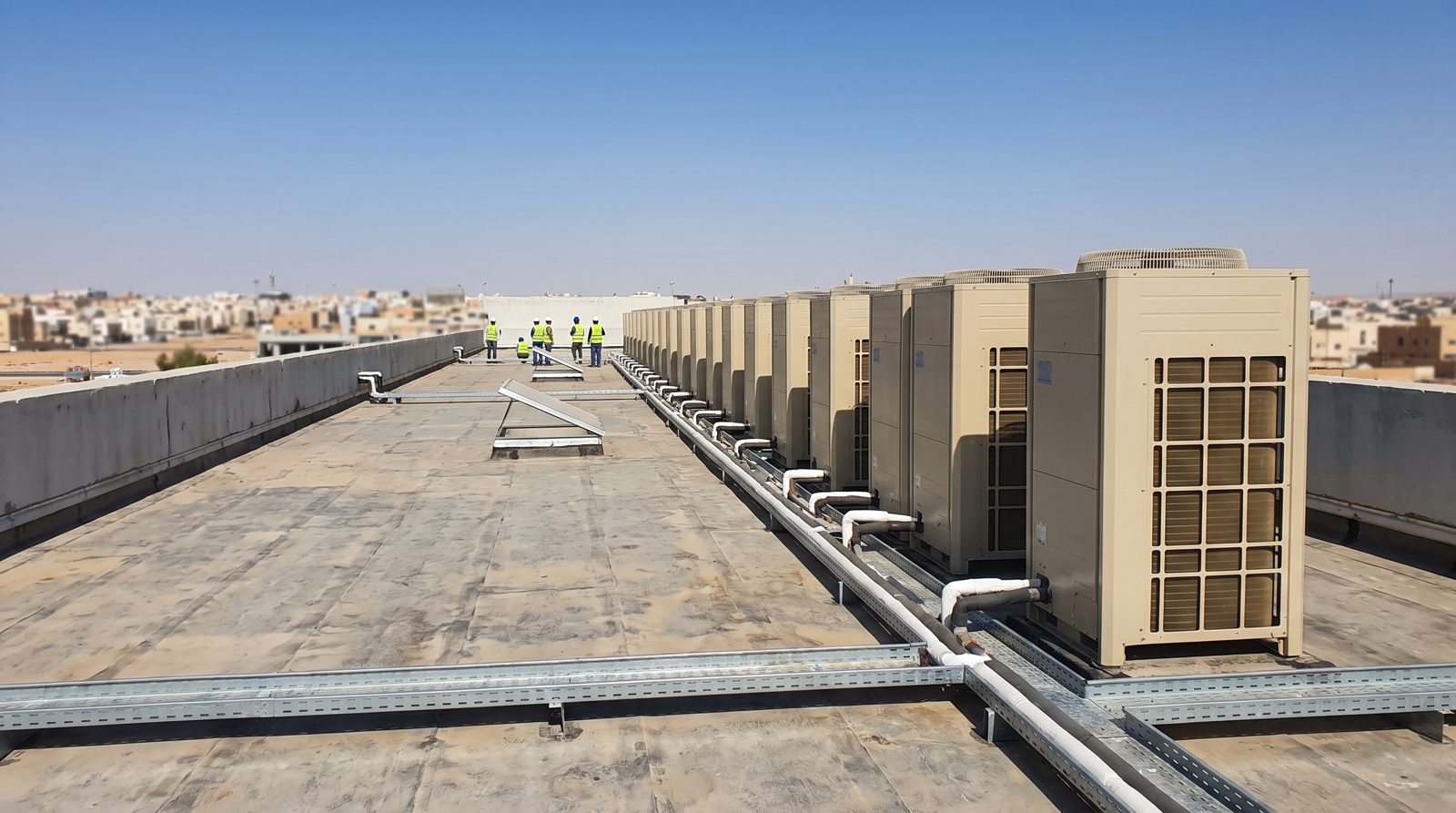
A VRF system is a direct-expansion (DX) air-conditioning system in which one outdoor condensing unit, or a combination of modular outdoor units, serves multiple indoor units through a single refrigerant piping network. Inverter-driven compressors vary their speed to match the total load, and electronic expansion valves at each indoor unit meter the refrigerant to suit the load in that zone. Indoor units can be ceiling cassettes, concealed ducted units, wall units or floor units, so one system can serve a mix of office floors, meeting rooms and corridors.
Two configurations are common. In a heat pump system, all indoor units on one system run in the same mode, either cooling or heating, and this is the usual choice where heating demand is small. In a heat recovery system, different indoor units on the same system can cool and heat at the same time, using either a three-pipe arrangement or a two-pipe arrangement with branch controllers, depending on the manufacturer.
VRF vs split AC for commercial buildings
Conventional split and ducted split units remain common in Saudi commercial buildings, especially in smaller retail units and older offices. The comparison below is for commercial and institutional scale, not individual rooms.
| Criterion | Split and ducted split units | VRF system |
|---|---|---|
| Outdoor units | One outdoor unit per indoor unit or zone, which crowds roofs and facades | One modular outdoor system serves many indoor units |
| Part-load operation | Each unit modulates on its own, and fixed-speed units cycle on and off | Inverter modulation across the whole system |
| Control | Local controllers, limited central visibility | Central controller and BMS integration as standard practice |
| Piping | Many short independent refrigerant circuits | One engineered refrigerant network per system, with tighter installation discipline |
| Best fit | Small, isolated spaces with simple occupancy | Multi-zone floors with varied loads and schedules |
For a commercial building with dozens of zones, VRF usually wins on control, roof space and part-load efficiency. For a small isolated space, a well-selected ducted split can be the simpler answer.
DX system vs chilled water system
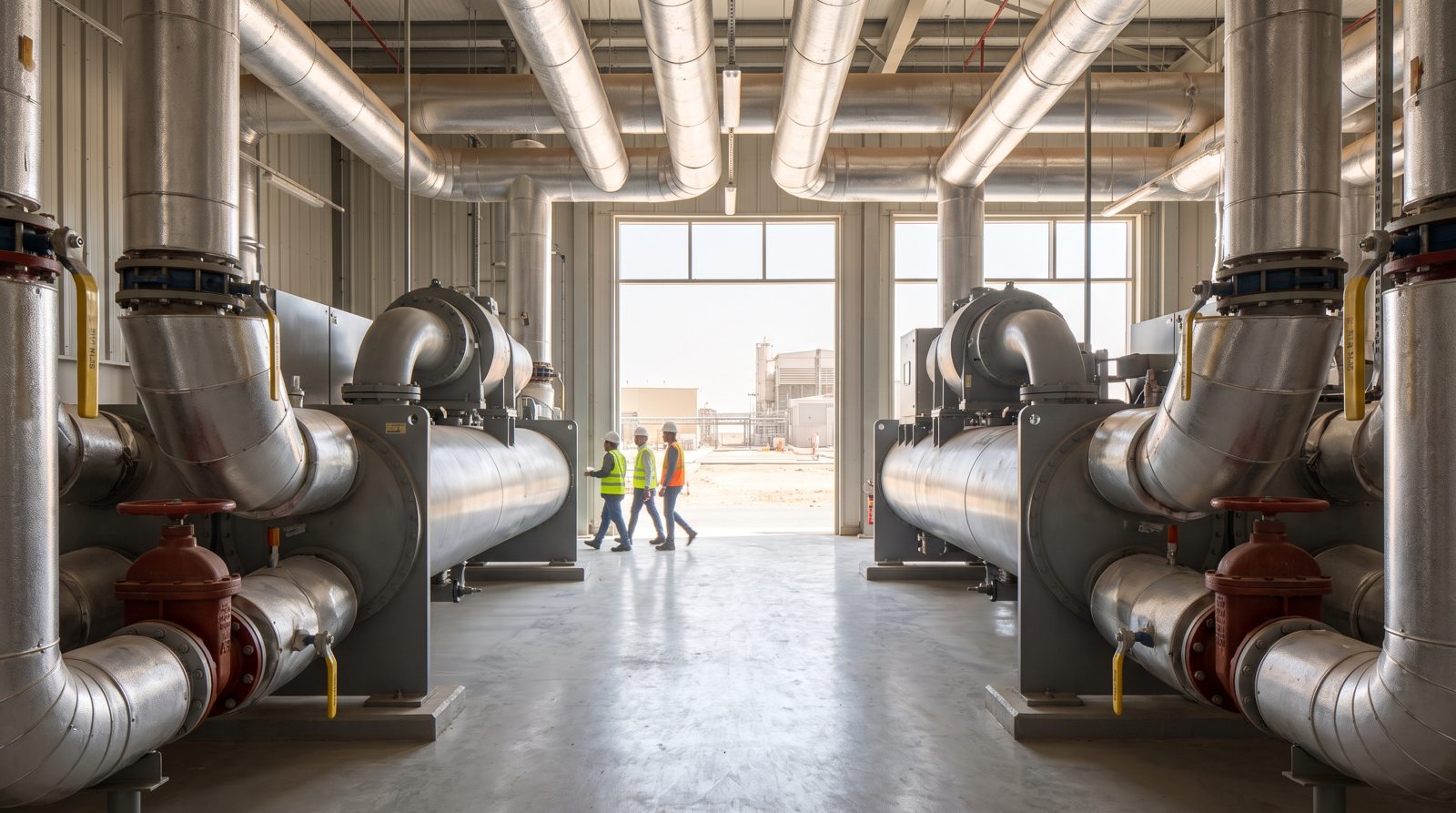
The deeper comparison is DX system vs chilled water system. In a DX system, including VRF, refrigerant evaporates directly in the indoor coil. In a chilled-water system, a central chiller cools water, which is pumped through insulated pipework to air handling units and fan coil units. The refrigerant stays inside the chiller.
| Criterion | DX (including VRF) | Chilled water |
|---|---|---|
| Heat transfer medium in the building | Refrigerant | Water |
| Typical scale | Small to medium loads, distributed systems | Medium to very large loads, central plant |
| Plant room | Not normally required | Required for chillers, pumps and, for water-cooled plant, cooling towers |
| Redundancy | Per system, so a failed system affects its own zones | Designed at plant level (for example N+1 chillers and standby pumps) |
| Humidity and fresh air control | Limited, and needs a separate DOAS | Strong, through AHUs with dedicated coils and controls |
| Thermal storage and district cooling | Not practical with VRF | Compatible with thermal energy storage and district cooling connections |
Where a chilled water plant is the better answer
We do not sell one system type for every building. In our engineering view, a chilled-water plant is usually the better answer than VRF in these situations:
- Large buildings and campuses. Once the cooling load runs into many hundreds of tons, dozens of separate VRF systems become harder to maintain and control than one plant.
- High-rise towers. Riser heights and piping lengths can exceed VRF manufacturer limits, while chilled-water systems handle height with pressure zoning.
- Hospitals, cleanrooms and laboratories. High fresh-air fractions, tight humidity and pressure control and documented redundancy favor AHUs on chilled water.
- Data centers and critical facilities. Concurrent maintainability and N+1 or 2N redundancy are easier to engineer at plant level.
- District cooling connections. Where a district cooling network is available or mandated, the building side is chilled water by definition.
- Long service life targets. Central chillers are generally planned for a longer service life than DX equipment.
For our chilled-water plant scope, see the White Arch HVAC services page.
Designing VRF for Saudi conditions
VRF performs well in the Kingdom when it is selected and installed for local conditions rather than catalog conditions.
- High ambient derating. Peak design dry-bulb temperatures in Riyadh are typically in the mid-40s °C, and the project value should come from ASHRAE climatic data. Many outdoor units are rated to operate up to roughly 43 to 46 °C (Daikin's VRV 5 range, for example, is rated to 46 °C in cooling), and some manufacturers offer extended-ambient models. Capacity falls as ambient rises, so selections must use derated capacity at the project design condition.
- Dust and sand. Coil spacing, anti-corrosion coatings for coastal sites in the Eastern Province, and accessible locations for coil cleaning all affect sustained capacity.
- Outdoor unit placement. Recirculation of hot discharge air between closely spaced units is a common cause of nuisance trips, so spacing and discharge ducting follow manufacturer clearances.
- Refrigerant concentration. Small rooms such as offices or hotel rooms on a large system need a check against ASHRAE 15 or ISO 5149 concentration limits, and leak detection where required.
- Energy rules. Equipment efficiency must meet the SASO requirements that apply and the project's energy code basis, typically SBC 601 for non-residential buildings.
VRV system installation in Riyadh: what sound practice looks like
Whether the equipment is VRV or another VRF brand, installation quality decides lifetime reliability. On our VRV system installation projects in Riyadh and across the Kingdom, the sequence is:
- Verify the piping design against manufacturer limits for length, level difference and branch selection.
- Braze copper with a nitrogen purge to prevent internal oxide scale, and use the manufacturer's branch joints and headers.
- Pressure test the refrigerant network with dry nitrogen to the manufacturer's test pressure and hold time.
- Evacuate to a deep vacuum and confirm it holds before charging.
- Calculate and record the additional refrigerant charge from as-built pipe lengths.
- Commission with the manufacturer's procedure, verify addressing and controls, and integrate with the BMS.
Choosing a VRF system supplier and installer in Saudi Arabia
Procurement teams choosing a VRF system supplier and installer in Saudi Arabia should judge the installer's competence separately from the equipment brand. Check that the installer can show manufacturer-trained technicians, brazing and pressure-testing method statements, a commissioning record format and coordination with the ventilation (DOAS) and electrical scopes. We deliver VRF/VRV, chilled-water plant and air distribution as one accountable contractor, with Kingdom-wide mobilization from Dammam. We hold ISO 9001, ISO 14001 and ISO 45001 certification and are an ARAMCO approved vendor, and our standards page sets out how quality and safety are controlled on each project. The wider scope is on the solutions page.