
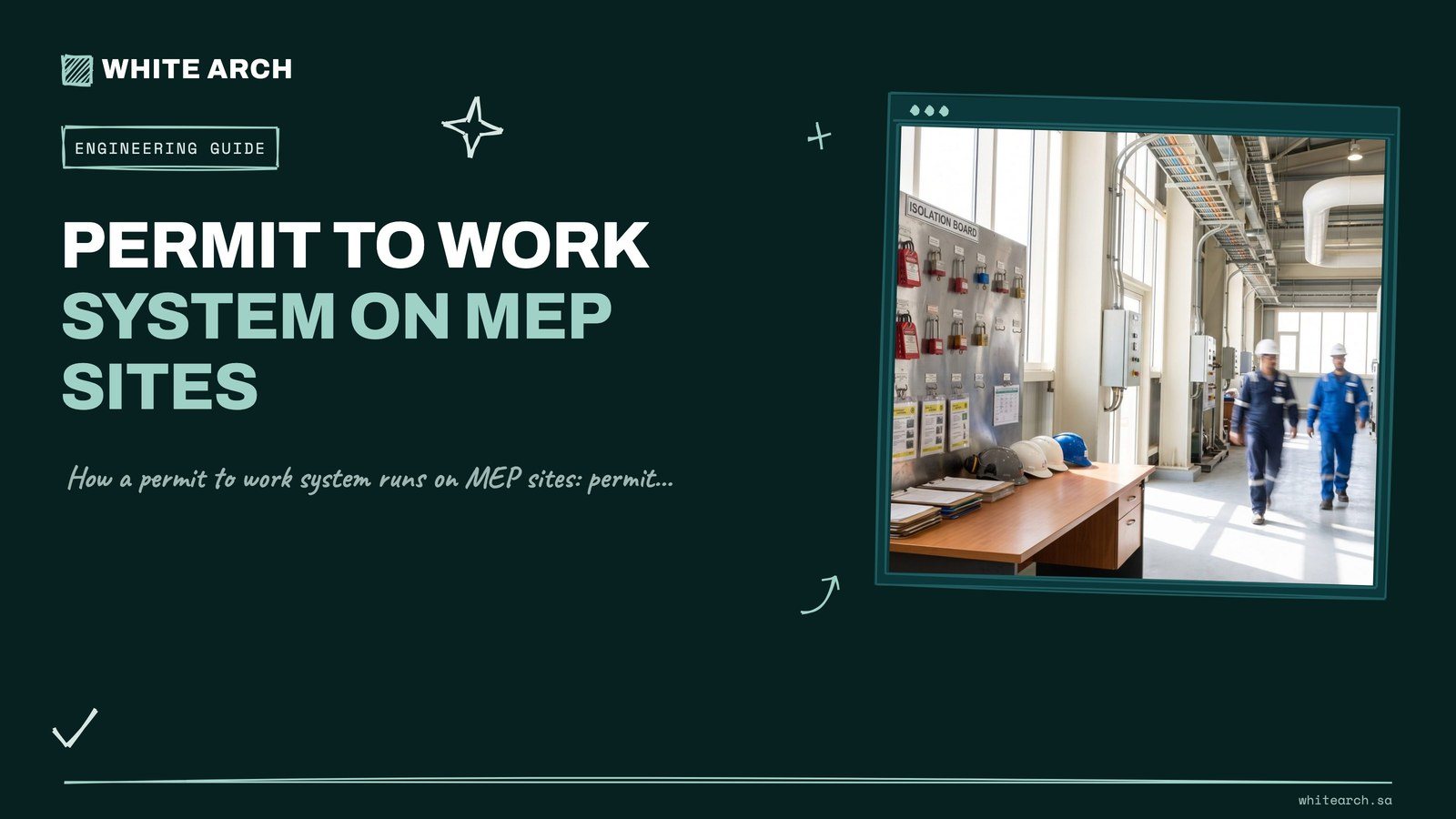
A permit to work system is a formal, written control that authorizes specific hazardous work at a specific location and time, only after the hazards have been identified, the plant has been isolated and the precautions have been checked and signed. On MEP sites it typically covers hot work, electrical isolation and lockout tagout, confined space entry and work at height, with isolation certificates linking each permit to the physical isolations that make the work safe.
- Why the permit is the control that matters
- Permit types on MEP sites
- The approval chain
- Isolation certificates and lockout tagout
- Simultaneous operations and permit conflicts
- MEP contractor HSE plan requirements
- ISO 45001 requirements checklist, explained for buyers
- ISO 9001 requirements checklist, explained for buyers
- How to verify an ISO certified MEP contractor in Saudi Arabia
Why the permit is the control that matters
A permit to work system is the point where an HSE plan stops being a document and becomes a decision about a real valve, breaker or manhole. On an operating hospital, data center, plant or tower, MEP work almost always touches live services: chilled-water mains, LV and MV switchgear, fire mains, drainage and risers. The permit to work system is what proves that each of those services has been isolated, tested and handed to the work party before anyone breaks a joint or opens a panel, and that it is handed back safely afterward.
For buyers, the quality of a contractor's permit to work system is one of the most reliable indicators of how they will behave on site. A contractor that understands permits writes method statements that match them, plans isolations before mobilization and closes permits properly at the end of each shift. This guide explains how a permit to work system operates on MEP sites, the permit types and approval chain, isolation certificates and lockout tagout, and what the ISO 45001 and ISO 9001 requirement checklists actually mean when a contractor is being prequalified.
Permit types on MEP sites
Most site permit systems use a general or cold work permit as the base and add specific permits or certificates for higher-risk activities. Names vary between owners, but the categories are consistent.
| Permit or certificate | Typical MEP tasks | Key controls before issue |
|---|---|---|
| Hot work | Welding, brazing, cutting, grinding on pipework, hot tapping fittings | Gas test where required, removal or protection of combustibles, fire watch, extinguishers, post-work fire watch period |
| Electrical isolation and LOTO | Work on switchgear, MDBs, distribution boards, motor circuits, chiller and AHU power | Isolation by an authorized person, locks and tags applied, test for dead, earthing where required |
| Confined space entry | Tanks, pits, sumps, ducts, some plenums and shafts | Atmosphere test, ventilation, attendant at the entry, rescue plan, entry log |
| Work at height | Risers, plant rooms with high-level services, cable tray and ductwork installation, rooftop plant | Suitable access equipment, edge protection or fall arrest, inspection of equipment, exclusion zone below |
| Line breaking and mechanical isolation | Opening chilled-water, condenser, fire or process lines, pipe freezing, valve replacement | Isolation proven, line depressurized and drained, positive isolation where required |
| Excavation | Buried services, drainage, external ring mains | Service detection, permit to dig, shoring or battering, barriers |
Several permits often apply to one job. Replacing a valve on a chilled-water line in a basement plant room may need a mechanical isolation certificate, a line-breaking permit, an electrical isolation for the pumps and, if the valve is welded, a hot work permit.
The approval chain
A permit only works if the roles behind it are clear. Titles differ between sites, but the chain normally follows this sequence:
- Performing authority (requester): The supervisor of the work party describes the job, location, equipment, duration and method statement reference, and requests the permit.
- Area or issuing authority: The person responsible for the plant or area confirms the work is compatible with operations and other activities, and specifies the precautions.
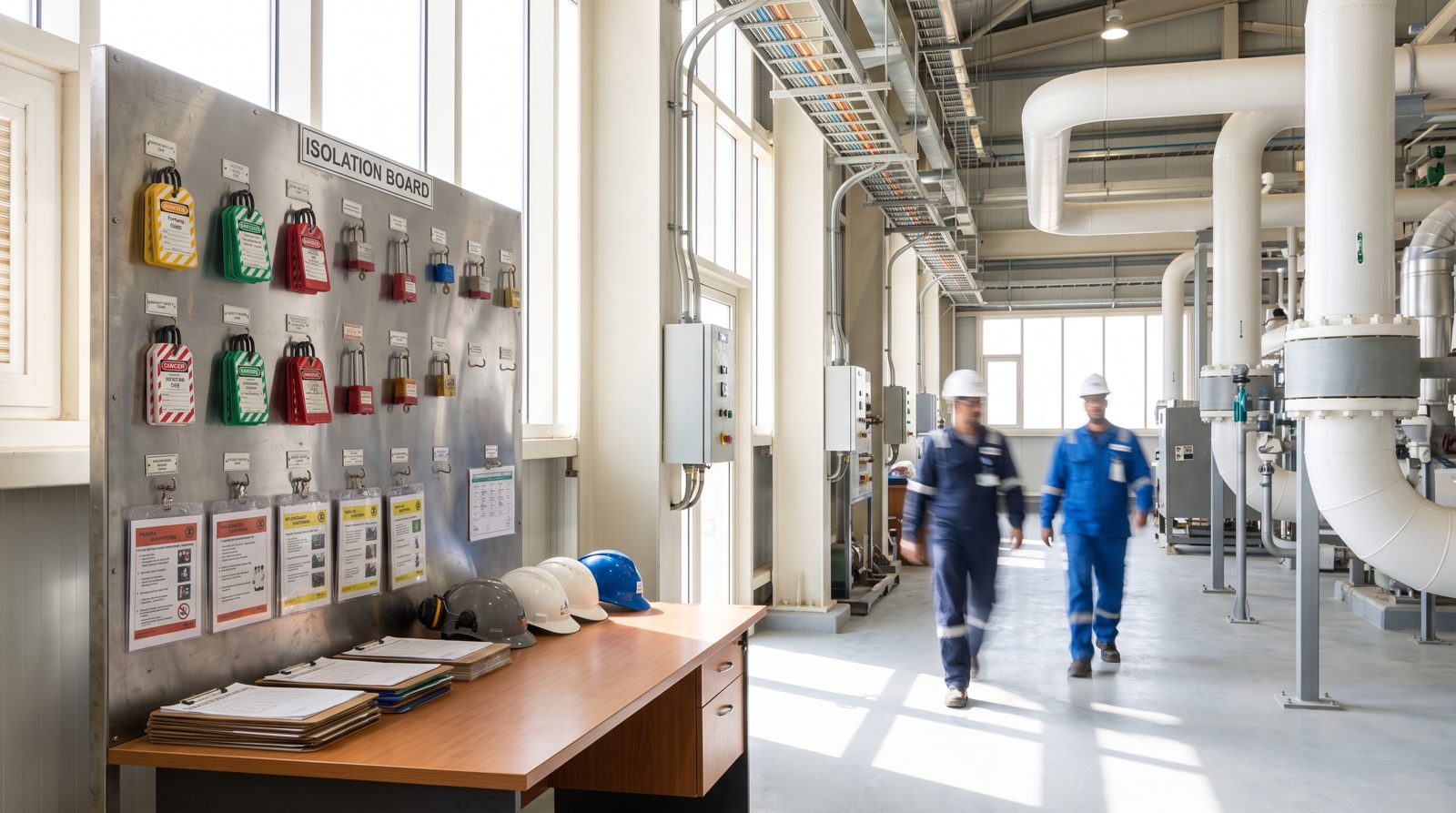
- Isolating authority: An authorized person carries out the electrical, mechanical or process isolations, applies locks and tags, and records them on an isolation certificate.
- Gas tester and specialist checks: Where required, atmosphere testing, fire watch arrangements or structural checks are completed and recorded.
- Permit issue and acceptance: The issuing authority signs the permit, the performing authority accepts it on behalf of the work party, and the permit is displayed at the work location.
- Suspension and revalidation: Permits are suspended at shift end or on changes in conditions, and revalidated before work resumes.
- Handback and close-out: The work party confirms the job is complete and the area is safe, isolations are removed in a controlled sequence, and the permit is closed and filed.
The value of the chain is separation: the person doing the work is not the person who decides the plant is safe to work on.
Isolation certificates and lockout tagout
An isolation certificate records every isolation point needed for a job, the method used at each point, who applied it and who verified it. It is cross-referenced to the permit, so the permit cannot be issued until isolation is complete and cannot be closed until isolation removal is controlled.
For electrical work, lockout tagout means the circuit is switched off, isolated at a lockable point, locked with a personal or group lock, tagged, and then proven dead with a tested voltage detector before work starts. Where several trades work on the same equipment, a group lockbox holds the isolation keys and each worker applies a personal lock to the box, so the isolation cannot be removed while anyone is still working.
For mechanical and piping work, the strength of isolation depends on the hazard. Closing a single valve may be acceptable for low-energy water services, while higher-hazard lines require double block and bleed or positive isolation with spades or blinds. Where no valve can isolate a water line at all, techniques such as pipe freezing or line stopping create a temporary isolation point, and these are written into the isolation certificate like any other isolation. White Arch plans these live-line isolations with technical survey, method statement and contingency, as described on the White Arch solutions page.
Simultaneous operations and permit conflicts
On busy sites the hazard often comes from the interaction between permits rather than any single task. Hot work above a confined space entry, electrical testing next to a line being opened, or two crews relying on the same isolation all create conflicts. A competent permit office reviews active permits on a board or system before issuing a new one, maps them to the plant, and suspends or sequences work where they overlap. Buyers should ask how a contractor identifies and reports conflicts, because the contractor's crews see the site at a level of detail the owner's office may not.
MEP contractor HSE plan requirements
The permit system sits inside the contractor's HSE plan. A project-specific HSE plan for MEP work usually covers:
- Scope, organization and named HSE responsibilities, including competent persons for isolation, lifting and scaffolding.
- Hazard identification and risk assessment for each activity, linked to method statements.
- The permit to work and isolation procedure, aligned with the owner's system rather than replacing it.
- Training and competence records, including authorized electrical and isolation personnel.
- Equipment inspection: lifting gear, access equipment, test instruments, cryogenic and hot tapping equipment.
- Emergency response and rescue arrangements for confined spaces and work at height.
- Incident reporting, investigation and corrective action.
- Monitoring: inspections, audits, toolbox talks and HSE performance reporting.
- Compliance with Saudi occupational safety requirements and the owner's site rules.
ISO 45001 requirements checklist, explained for buyers
ISO 45001 is the international standard for occupational health and safety management systems. It does not prescribe a permit form; it requires an organization to run a system that identifies hazards and controls risk, and permits are one of the controls that system should produce. The checklist below follows the standard's main clauses.
| Clause area | What it requires | What a buyer can ask for |
|---|---|---|
| Context (clause 4) | Understanding internal and external issues, interested parties and the scope of the system | The certificate scope and whether it covers site construction and maintenance work |
| Leadership and worker participation (clause 5) | Top management commitment, OH&S policy, roles, consultation and participation of workers | The OH&S policy and evidence of worker consultation such as safety committees |
| Planning (clause 6) | Hazard identification, risk assessment, legal requirements, objectives | A sample risk assessment and legal register |
| Support (clause 7) | Competence, awareness, communication, documented information | Training matrix and authorization records for isolation work |
| Operation (clause 8) | Operational control using the hierarchy of controls, management of change, control of contractors and outsourcing, emergency preparedness | Permit and isolation procedure, management of change records, emergency drills |
| Performance evaluation (clause 9) | Monitoring, internal audit, management review | Recent internal audit summary and HSE statistics |
| Improvement (clause 10) | Incident investigation, nonconformity, corrective action, continual improvement | A closed-out incident investigation with corrective actions |
ISO 9001 requirements checklist, explained for buyers
ISO 9001 covers quality management. On MEP projects it governs how submittals, inspections and handover records are controlled, which is why it matters even for safety-critical live work.
| Clause area | What it requires | What a buyer can ask for |
|---|---|---|
| Context and leadership (clauses 4 and 5) | Scope, quality policy, roles and customer focus | Certificate scope and quality policy |
| Planning (clause 6) | Risks and opportunities, quality objectives | Project quality plan |
| Support (clause 7) | Resources, calibrated measuring equipment, competence, document control | Calibration certificates for test instruments, document control procedure |
| Operation (clause 8) | Planning of work, control of suppliers, control of site work, release of work, control of nonconforming outputs | Inspection and test plans, material approval and inspection records, nonconformance reports |
| Performance evaluation (clause 9) | Customer feedback, internal audit, management review | Audit and review records |
| Improvement (clause 10) | Corrective action and continual improvement | Corrective action log |

How to verify an ISO certified MEP contractor in Saudi Arabia
Buyers searching for an ISO certified MEP contractor in Saudi Arabia, or an ISO 45001 HSE compliant contractor, should verify rather than accept a logo. ISO itself develops the standards and does not certify companies; certificates are issued by certification bodies, which should be accredited by a recognized accreditation body. A practical check covers four points: the certificate names the same legal entity as the commercial registration, the scope covers the work being tendered, the certificate is in date, and it can be confirmed with the issuing body or a database such as IAF CertSearch. Background on the standards is available from ISO.
Certification is evidence that a system exists and has been audited. It is not a substitute for reviewing the contractor's actual permit procedure, isolation records and method statements for the job in hand. The quality and safety approach White Arch applies to live MEP work is set out on the standards page, and its MEP scope on the electrical and MEP services page.