
BTU to Ton Conversion: Sizing Cooling Capacity the Right Way

One ton of refrigeration (TR) equals 12,000 BTU per hour, which equals 3.517 kW of cooling. To convert, divide BTU/h by 12,000 to get tons, and multiply tons by 3.517 to get kW. For chiller efficiency, the chiller COP calculation is COP = 3.517 / (kW per ton), and EER = 12 / (kW per ton).
- Why the BTU to ton conversion matters
- BTU to ton conversion table
- Where the 12,000 BTU/h figure comes from
- Tons of refrigeration from chilled-water flow
- Chiller kW per ton and COP
- EER vs SEER vs IPLV: what each rating measures
- Worked calculator: from BTU/h to kW, input power and COP
- How White Arch applies this on projects
Why the BTU to ton conversion matters
The BTU to ton conversion is the first calculation on every commercial chiller plant, and it is also where many capacity disputes begin. A BTU to ton conversion divides heat removal in BTU per hour by 12,000, and the result is tons of refrigeration (TR), the unit in which most chillers, cooling towers and district cooling contracts are still quoted. Equipment schedules and vendor data sheets mix kW, tons and BTU/h, so a reliable BTU to ton conversion habit prevents selection errors that otherwise surface only at commissioning.
This guide is written for facility managers, MEP consultants and developers reviewing plant capacity on commercial towers, hospitals, data centers, malls and campuses. It sets out the BTU to ton conversion table, explains where the 12,000 figure comes from, connects tons of refrigeration to chiller kW per ton and COP, and defines EER vs SEER vs IPLV so that vendor efficiency figures can be compared on one basis. Every figure is a standard engineering constant or a direct calculation from one. Project values must still be confirmed against the current ASHRAE handbook, the AHRI standard and the Saudi Building Code edition in force.
BTU to ton conversion table
The table below uses 1 TR = 12,000 BTU/h = 3.517 kW (more precisely 3.5169 kW). Values are rounded to one decimal place.
| Tons of refrigeration (TR) | BTU per hour (BTU/h) | Kilowatts (kW) |
|---|---|---|
| 1 | 12,000 | 3.5 |
| 5 | 60,000 | 17.6 |
| 10 | 120,000 | 35.2 |
| 25 | 300,000 | 87.9 |
| 50 | 600,000 | 175.8 |
| 100 | 1,200,000 | 351.7 |
| 250 | 3,000,000 | 879.2 |
| 500 | 6,000,000 | 1,758.4 |
| 1,000 | 12,000,000 | 3,516.9 |
| 2,500 | 30,000,000 | 8,792.1 |
The reverse factors are equally useful on site.
| To convert | Into | Multiply by |
|---|---|---|
| BTU/h | TR | 1 / 12,000 (0.0000833) |
| TR | BTU/h | 12,000 |
| TR | kW | 3.517 |
| kW | TR | 0.2843 |
| kW | BTU/h | 3,412 |
| BTU/h | W | 0.2931 |
The exact figure follows from the definition of the BTU. One International Table BTU is 1,055.056 joules, so 12,000 BTU/h = 12,000 × 1,055.056 / 3,600 = 3,516.85 W. Designers round this to 3.517 kW, and the rounding error is below 0.01 percent.
Also read: Cooling Load Calculation for Buildings in Saudi Arabia: Design Conditions and Method
Where the 12,000 BTU/h figure comes from
A ton of refrigeration is defined as the rate of heat removal needed to melt one short ton (2,000 lb) of ice at 32°F over 24 hours. The latent heat of fusion of ice is about 144 BTU per pound, so 2,000 lb × 144 BTU/lb = 288,000 BTU per day. Dividing by 24 hours gives 12,000 BTU/h. The unit is a rate of heat removal, not a weight and not an electrical input, which is the single most common misunderstanding in capacity reviews.
That distinction matters because a "500 TR chiller" describes cooling delivered to the chilled-water loop at a stated rating condition. It says nothing about the electrical power drawn, the condenser heat rejected (cooling capacity plus compressor work) or the capacity available at site summer conditions. Each of those is a separate figure on the selection sheet and should be checked separately.

Tons of refrigeration from chilled-water flow
On an operating plant, tons of refrigeration are rarely read from a nameplate. They are calculated from measured flow and temperature difference across the evaporator. Two forms of the same equation are in use.
| Units | Equation | Notes |
|---|---|---|
| SI | Cooling (kW) = flow (L/s) × 4.19 × ΔT (K) | Water at about 1 kg per liter and a specific heat of about 4.19 kJ/kg·K |
| Inch-pound | Tons = flow (US gpm) × ΔT (°F) / 24 | The simplified form of 500 × gpm × ΔT / 12,000 |
Glycol mixtures, which are uncommon in comfort cooling but appear in some process and low-temperature applications, have lower specific heat and require a correction from the fluid supplier's data. Flow meters, temperature sensors and their calibration certificates are part of any credible capacity test, which is why we treat them as commissioning deliverables, not optional extras. More on how we approach plant work is on our HVAC services page.
Also read: VRF and VRV Systems: Advantages, Limits and Where They Beat Conventional AC
Chiller kW per ton and COP
Chiller kW per ton is the electrical input in kW divided by the cooling output in tons. Lower is better. The coefficient of performance (COP) is the ratio of cooling output to electrical input in the same units, so higher is better. Because 1 TR = 3.517 kW of cooling, the two figures convert directly, and a chiller COP calculation takes one line.
| Quantity | Formula | Reason |
|---|---|---|
| COP from kW per ton | COP = 3.517 / (kW per ton) | 1 TR is 3.517 kW of cooling |
| kW per ton from COP | kW per ton = 3.517 / COP | Inverse of the line above |
| EER from kW per ton | EER = 12 / (kW per ton) | EER is BTU/h of cooling per watt of input |
| EER from COP | EER = COP × 3.412 | One watt is 3.412 BTU/h |
| kW per ton | COP | EER (BTU/h per W) |
|---|---|---|
| 0.50 | 7.03 | 24.0 |
| 0.55 | 6.39 | 21.8 |
| 0.60 | 5.86 | 20.0 |
| 0.70 | 5.02 | 17.1 |
| 1.00 | 3.52 | 12.0 |
| 1.20 | 2.93 | 10.0 |
| 1.40 | 2.51 | 8.6 |
As a broad orientation only, water-cooled centrifugal and screw chillers at standard rating conditions commonly fall in the lower part of this table, while air-cooled chillers sit higher. ASHRAE 90.1 sets minimum full-load and IPLV efficiency by chiller type and capacity, and the Saudi energy code SBC 601 applies to non-residential buildings; confirm the editions named in the project specification at sbc.gov.sa. Efficiency is worth the attention: SEEC, via Saudipedia notes that air conditioning units alone consume over half of the electricity produced in the Kingdom.
Chiller COP calculation from a measured plant
A chiller drawing 203 kW to deliver 1,231 kW of cooling has a COP of 1,231 / 203 = 6.06, which is 0.58 kW per ton. The chiller COP calculation works the same way with any consistent pair of units, so it can be run directly from a power meter and the evaporator flow and temperature readings described above.
Rating conditions versus site conditions
Rated tons and kW per ton apply at the standard rating conditions of AHRI 550/590, not at site design conditions. The table compares those conditions with Gulf site design values from Saudi Aramco SAES-A-112, which lists a 1% summer design dry-bulb of 45 °C at Dhahran and 44 °C at Riyadh, and design wet-bulb values of 32 °C and 22 °C.
| Item | AHRI 550/590 rating condition | Site design example | Difference |
|---|---|---|---|
| Air-cooled chiller entering air | 35 °C | 45 °C at Dhahran, 44 °C at Riyadh | About 10 K and 9 K above the rating condition |
| Water-cooled chiller entering condenser water | 29.4 °C | About 36 °C at Dhahran and 26 °C at Riyadh, assuming an illustrative 4 K tower approach to the design wet-bulb | About 6.6 K above at Dhahran, 3.4 K below at Riyadh |
| Chilled-water leaving and entering temperature | 6.7 °C and 12.2 °C (a 10°F rise) | Project specific, for example a 7 K rise | Flow per ton falls from 2.4 gpm to about 1.9 gpm |
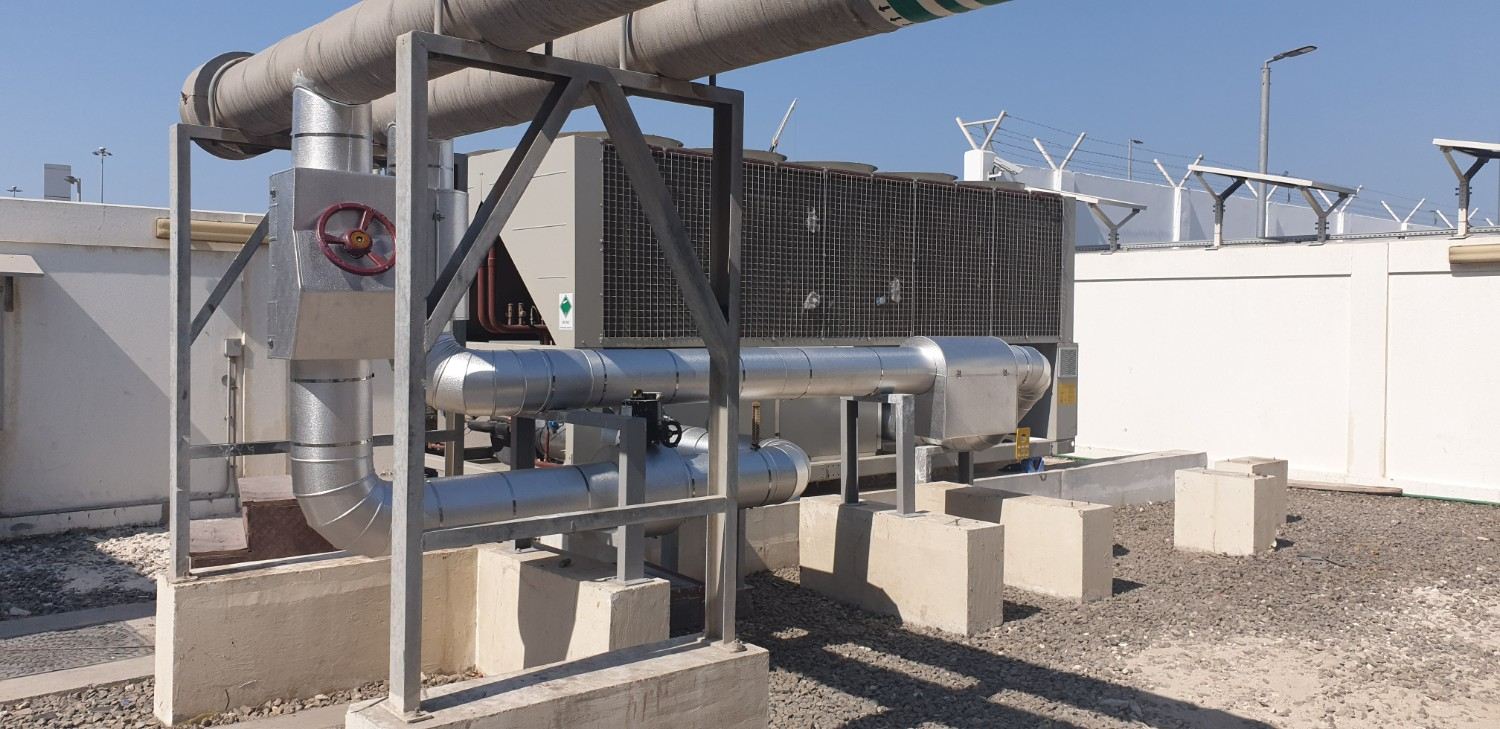
A higher condensing temperature means the compressor lifts against more pressure, so capacity falls and kW per ton rises. A chiller that meets its rating at the standard condition can therefore underdeliver at a hot-coast site, while the same water-cooled model at an inland site with a low wet-bulb can do better than its rating.
Chiller-only versus whole-plant kW per ton
A chiller's kW per ton excludes chilled-water pumps, condenser-water pumps, cooling tower fans and controls. Whole-plant kW per ton includes them and is always higher than the chiller figure alone. When a consultant or operator compares two plants, the first question is which of the two figures is being quoted. Facility teams that track whole-plant kW per ton from metered data have a far better picture of real operating cost than any nameplate rating.
EER vs SEER vs IPLV: what each rating measures
These three metrics are frequently placed side by side in tenders as if they were interchangeable. They are not.
| Metric | Definition | Typical use | Basis |
|---|---|---|---|
| EER | Cooling output in BTU/h divided by power input in W at one full-load rating condition | Packaged and unitary equipment, and as a snapshot for chillers | Single operating point |
| SEER | Seasonal cooling output divided by seasonal energy input for smaller unitary equipment (SEER2 under the current US test procedure) | Small unitary air conditioners and heat pumps (AHRI 210/240 scope) | Seasonal weighting, small units only |
| IEER | Integrated part-load metric for larger commercial unitary equipment | Rooftop and packaged units (AHRI 340/360) | Weighted at 100, 75, 50 and 25% load |
| IPLV | Integrated Part Load Value for chillers, weighted at 100, 75, 50 and 25% load at standard rating conditions | Water-cooled and air-cooled chillers (AHRI 550/590) | Weighted part-load |
| NPLV | Same weighting as IPLV, calculated at non-standard (project) conditions | Chiller selections at the project's own water temperatures | Weighted part-load |
In the EER vs SEER vs IPLV comparison, SEER is a seasonal metric for small unitary equipment and has no role in specifying a commercial chiller plant. For chillers, the relevant pair is full-load kW per ton (or COP) and IPLV or NPLV.
How IPLV is calculated
AHRI 550/590 weights chiller performance at four load points: 1% at 100% load, 42% at 75%, 45% at 50% and 12% at 25%. When efficiency is expressed as COP or EER (higher is better), IPLV = 0.01A + 0.42B + 0.45C + 0.12D, where A to D are the efficiencies at 100, 75, 50 and 25% load. When efficiency is expressed in kW per ton (lower is better), the standard uses the inverse form: IPLV = 1 / (0.01/A + 0.42/B + 0.45/C + 0.12/D). The weighting assumes a single chiller over a typical operating year; it does not represent a multi-chiller plant where sequencing keeps each machine at a higher load. Use IPLV to compare chillers, and an hourly energy model to compare plants.
Also read: Voltage Drop Calculation for Building Electrical Design: Formula, Limits and Worked Examples
Worked calculator: from BTU/h to kW, input power and COP
The table shows the full chain for a commercial office block with a calculated peak cooling load of 4,200,000 BTU/h, served by a water-cooled chiller with a selected full-load efficiency of 0.58 kW per ton. The figures are illustrative, and the last rows close with the chiller COP calculation; real loads must come from a cooling load calculation to ASHRAE methods.
| Step | Calculation | Result |
|---|---|---|
| 1. Load in tons | 4,200,000 / 12,000 | 350 TR |
| 2. Load in kW | 350 × 3.517 | 1,230.9 kW |
| 3. Chiller input power at full load | 350 × 0.58 | 203.0 kW |
| 4. Chiller COP calculation | 3.517 / 0.58 | 6.06 |
| 5. EER | 12 / 0.58 | 20.7 BTU/h per W |
| 6. Heat rejected at condenser (approx.) | 1,230.9 + 203.0 | 1,433.9 kW |
A field check of the same logic: a chiller passing 50 L/s of water with a 7 K evaporator temperature difference delivers approximately 50 × 4.19 × 7 = 1,466.5 kW, or about 417 TR. In inch-pound units, 800 gpm at a 10°F difference gives 800 × 10 / 24 = about 333 TR.

Common sizing mistakes on commercial plants
- Treating nameplate tons as site capacity: air-cooled chillers lose capacity as ambient temperature rises, so the selection must be checked at the project's design ambient.
- Confusing input and output: a 350 TR chiller does not draw 350 kW, and a 1,230 kW cooling load is not 1,230 kW of electrical demand.
- Ignoring diversity and redundancy: plant capacity is set by the block load with diversity, then by the redundancy philosophy (for example N+1 for hospitals and data centers), not by summing every zone peak.
- Mixing up EER vs SEER vs IPLV in a tender: the three metrics use different test procedures and equipment scopes.
- Skipping the rule-of-thumb check entirely, or relying on it entirely: area-based tons figures are useful only as a sanity check on a proper load calculation.
- Quoting chiller kW per ton for one plant and whole-plant kW per ton for another.
- Skipping the chiller COP calculation from measured data, so claimed efficiency is never checked against the meter.
How White Arch applies this on projects
We design, install and commission chilled-water plants for commercial, institutional and critical facilities across the Kingdom, mobilizing from our Dammam base. On capacity reviews, we verify the BTU/h, tons and kW figures across the load calculation, equipment schedule and vendor selection, confirm that efficiency figures such as chiller kW per ton are quoted on a consistent basis, repeat the chiller COP calculation from metered power, and document measured capacity during testing, balancing and commissioning. For plant scopes, see our chiller installation and replacement page, and for regional delivery our HVAC contractor in Riyadh and HVAC contractor in Dammam pages. The sectors we serve are on our markets page, and the wider service range is in our solutions overview. When a bid mixes EER vs SEER vs IPLV figures, we ask the vendor to restate them on one basis.
Standards worth keeping to hand are the ASHRAE Handbook (Fundamentals for load calculation), AHRI 550/590 for chiller ratings, and the current Saudi Building Code volumes published at sbc.gov.sa.