
Data Center Cooling and MEP Contracting in Saudi Arabia
We install and commission precision cooling, chilled-water plant and LV/MV distribution for concurrent maintainability, using live-line techniques that keep the white space running.
Request proposal WhatsApp +966 57 048 3020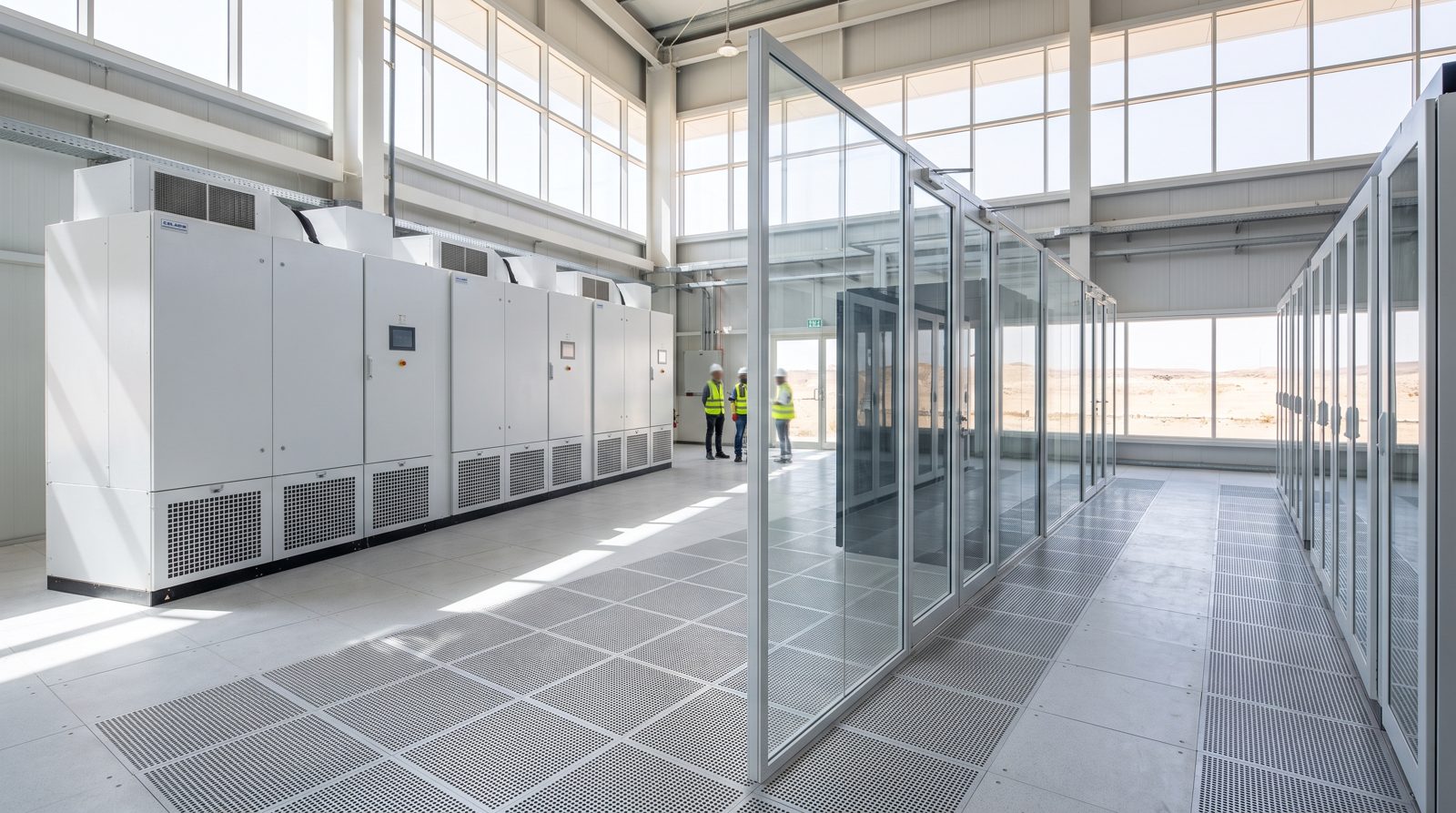
White Arch is a data center MEP contractor in Saudi Arabia for precision cooling, chilled-water systems and LV/MV distribution built around availability: redundant components (N+1 or 2N), alternate distribution paths and valving that let any element be maintained without shutting down the white space. We deliver the scope as one accountable contractor, and we use hot tapping and pipe freezing to work on live chilled-water systems without taking the hall down.
Data center MEP contractor in Saudi Arabia: concurrent maintainability built in
A data center MEP contractor in Saudi Arabia is judged less by installed tonnage than by uptime during construction, testing and every future maintenance window. We act as the data center MEP contractor in Saudi Arabia that project teams can hold accountable for precision cooling in the data hall, the chilled-water plant and piping that serve it, the LV/MV switchgear and busway that feed UPS and IT loads, and the controls that tie them together, instead of splitting cooling and power across separate subcontractors.
Choosing a data center MEP contractor in Saudi Arabia starts with one question: can every component be isolated, removed and replaced while the IT load stays online? That property, concurrent maintainability, has to be built into valve positions, pipe routes, breaker arrangements and control sequences from the first coordinated drawing. A data center MEP contractor in Saudi Arabia that understands it will challenge a design where a single header valve, a shared strainer or a common control panel quietly removes the redundancy the client paid for. We review drawings with that lens before installation starts, through our HVAC services and electrical and MEP teams, and we are the data center MEP contractor in Saudi Arabia that can also work on live systems.
Saudi Arabia data center market: what drives the MEP scope
The Saudi Arabia data center market is growing fast, and the published numbers show the scale. The table lists the main figures, and the arithmetic below it turns IT load into cooling load.
| Measure | Published figure | Source |
|---|---|---|
| Installed IT power capacity, Q1 2025 | About 222 MW | S&P Global |
| Planned additions by 2030 | About 760 MW, with IT load growing at a 29% CAGR from 2024 to 2030 | S&P Global |
| National Data Center Strategy target | About 1.5 GW of capacity by 2030, launched in 2025 by the Ministry of Communications and Information Technology with SDAIA | Greenberg Traurig advisory |
| Targeted investment | Over USD 18 billion under the strategy | Aranca special report |
| Share of capacity by city | Dammam 46.6%, Riyadh 40.0%, Jeddah 7.0% | Aranca special report |
Cooling follows IT power almost one for one, because nearly all IT electricity ends up as heat. One megawatt of IT load rejects about one megawatt of heat, which is about 284 tons of refrigeration (1,000 kW divided by 3.517), as our BTU to ton conversion guide explains. The 760 MW of planned additions therefore implies roughly 216,000 tons of refrigeration of heat rejection before any plant redundancy is added.
The Saudi Arabia data center market also sets the climate brief. Saudi Aramco SAES-A-112 lists a 1% summer design dry-bulb of 44 °C at Riyadh and 45 °C at Dhahran, next to Dammam, and a design wet-bulb of 32 °C at Dhahran, so heat rejection, economizer hours and filtration all work harder than in a temperate reference design. Our cooling load calculation guide sets out the design conditions in full.
Tier 3 data center requirements explained
The Uptime Institute Tier Standard: Topology defines four levels of site infrastructure. The Tier 3 data center requirements are the most commonly specified level for enterprise and colocation facilities, and Tier III is defined as concurrently maintainable: every capacity component and every element of the distribution paths can be taken out of service on a planned basis without affecting the IT equipment. Tier III and Tier IV facilities already operate in Riyadh (DatacenterDynamics).
| Tier (Uptime) | Definition | Capacity components | Distribution paths |
|---|---|---|---|
| Tier I | Basic capacity | N (no redundancy) | Single path |
| Tier II | Redundant capacity components | N+1 | Single path |
| Tier III | Concurrently maintainable | N+1 (redundant) | Multiple independent paths, one active at a time is acceptable |
| Tier IV | Fault tolerant | Redundant after any single failure (often 2N) | Multiple simultaneously active paths, compartmentalized, continuous cooling |
The Tier 3 data center requirements that most affect mechanical and electrical installation are below.
N+1 capacity components
Chillers, pumps, cooling towers or dry coolers, CRAH units, UPS modules and engine generators each include at least one redundant unit beyond the quantity (N) needed for design load.
Multiple distribution paths
Chilled-water piping and power feeds have an alternate path, so a pipe section, valve, switchboard or busway can be isolated while the other path serves the load. Only one path needs to be active.
Dual-powered IT equipment
IT equipment is fed from two independent sources, or through point-of-use transfer switches for single-corded loads.
Isolation at every element
Valves, breakers and bypasses are positioned so that each component can be removed without draining a shared section or de-energizing a common bus.
Engine generators as the primary source
The Tier Standard treats on-site generation, not the utility, as the source the design depends on, with on-site fuel storage sized to the standard.
The table shows how the Tier 3 data center requirements for N+1 become equipment counts, alongside N and 2N, for an illustrative 2 MW IT load, which needs about 569 tons of refrigeration, using 200 TR chillers.
| Scheme | Chillers (200 TR each) | What it means |
|---|---|---|
| N | 3 (600 TR) | Exactly the design load, so any failure or maintenance reduces capacity |
| N+1 | 4 (800 TR) | One chiller can be out of service and the load is still carried |
| 2N | 6 (two systems of 3) | Two complete systems, each able to carry the full load alone |
ANSI/TIA-942 is a separate telecommunications infrastructure standard with its own rating levels (Rated-1 to Rated-4) covering architecture, electrical, mechanical and telecommunications, and EN 50600 is the European equivalent with availability classes. The schemes are not interchangeable, and Uptime Tier certification is issued only by the Uptime Institute, so the specification should name one scheme clearly. We are not a certifier. We build the installation so the design can pass whichever scheme the client names, including the Tier 3 data center requirements.
Data center HVAC contractor in Riyadh and Dammam
With the Saudi Arabia data center market concentrated in Dammam and Riyadh, which together hold most of the Kingdom's capacity, a data center HVAC contractor in Riyadh or Dammam works in the two hardest climates for heat rejection and the two busiest markets. As a data center HVAC contractor in Riyadh, we mobilize a dedicated site team from our Dammam headquarters, and our regional scope is described on our HVAC contractor in Riyadh and HVAC contractor in Dammam pages. The table shows how local conditions change the installation.
| Site condition | Effect on data center cooling | What we do |
|---|---|---|
| Design dry-bulb of 44 to 45 °C (Saudi Aramco SAES-A-112) | Heat rejection works at a high ambient, and economizer hours shrink | Select heat rejection at the site design ambient, with spacing that avoids recirculation |
| Coastal wet-bulb of 32 °C at Dhahran | Water-cooled plant has less tower approach to work with | Check condenser water temperature and tower selection against the design wet-bulb |
| Airborne dust, usually 1 mg/m³ and up to 500 mg/m³ in sandstorms | Filter loading and coil fouling | Staged filtration, sealed hall envelope and accessible coils |
| Long cooling season | Very high annual run hours | Controls tuned for part-load efficiency, with redundancy proven in testing |
Precision cooling installation for data centers in Saudi Arabia
Precision cooling installation for data centers in Saudi Arabia is mostly chilled-water based at scale, with DX units for smaller rooms and edge sites. Precision units are selected for a sensible heat ratio close to 1, because IT heat is almost entirely sensible. As a data center cooling contractor in Saudi Arabia, we install and commission the following.
CRAH units and fan walls
Chilled-water computer room air handlers on raised floor or slab, with EC fans and modulating valves controlled on supply or rack-inlet temperature.
In-row and rear-door cooling
Close-coupled units for higher-density rows, with secondary piping, leak detection and isolation valves at each unit.
Chilled-water plant and loops
Chillers, primary and secondary pumps, heat rejection and looped or dual-header distribution arranged for concurrent maintainability.
Hot and cold aisle containment
Containment, blanking and cable-cutout sealing that keep supply and return air separated so units can run at higher return temperatures.
Liquid cooling readiness
Valved tap-off points and space for coolant distribution units (CDUs) where future direct-to-chip racks are planned.
Controls and monitoring
BMS integration, alarm points, valve position feedback and trend logging that prove redundancy works under failure.

The ASHRAE TC 9.9 thermal guidelines set the temperature and humidity envelope the cooling must hold. The recommended range is the same for the main equipment classes, and the allowable ranges widen by class.
| ASHRAE TC 9.9 item | Typical value | Use in design |
|---|---|---|
| Recommended inlet temperature | 18 to 27 °C | Design target for most IT equipment |
| Recommended moisture limits | Dew point from minus 9 °C to 15 °C, and 60% relative humidity at most | Humidity control and dehumidification limits |
| Allowable inlet range, class A1 | 15 to 32 °C | Excursions and failure scenarios |
| Allowable inlet range, class A2 | 10 to 35 °C | Excursions and failure scenarios |
Values vary by edition and by the IT vendor. Confirm them against the current ASHRAE edition and the equipment specification. Designing toward the upper part of the recommended range raises chilled-water supply temperatures, which improves chiller efficiency and cuts unwanted dehumidification.
Chilled-water plant for a data center cooling contractor in Saudi Arabia
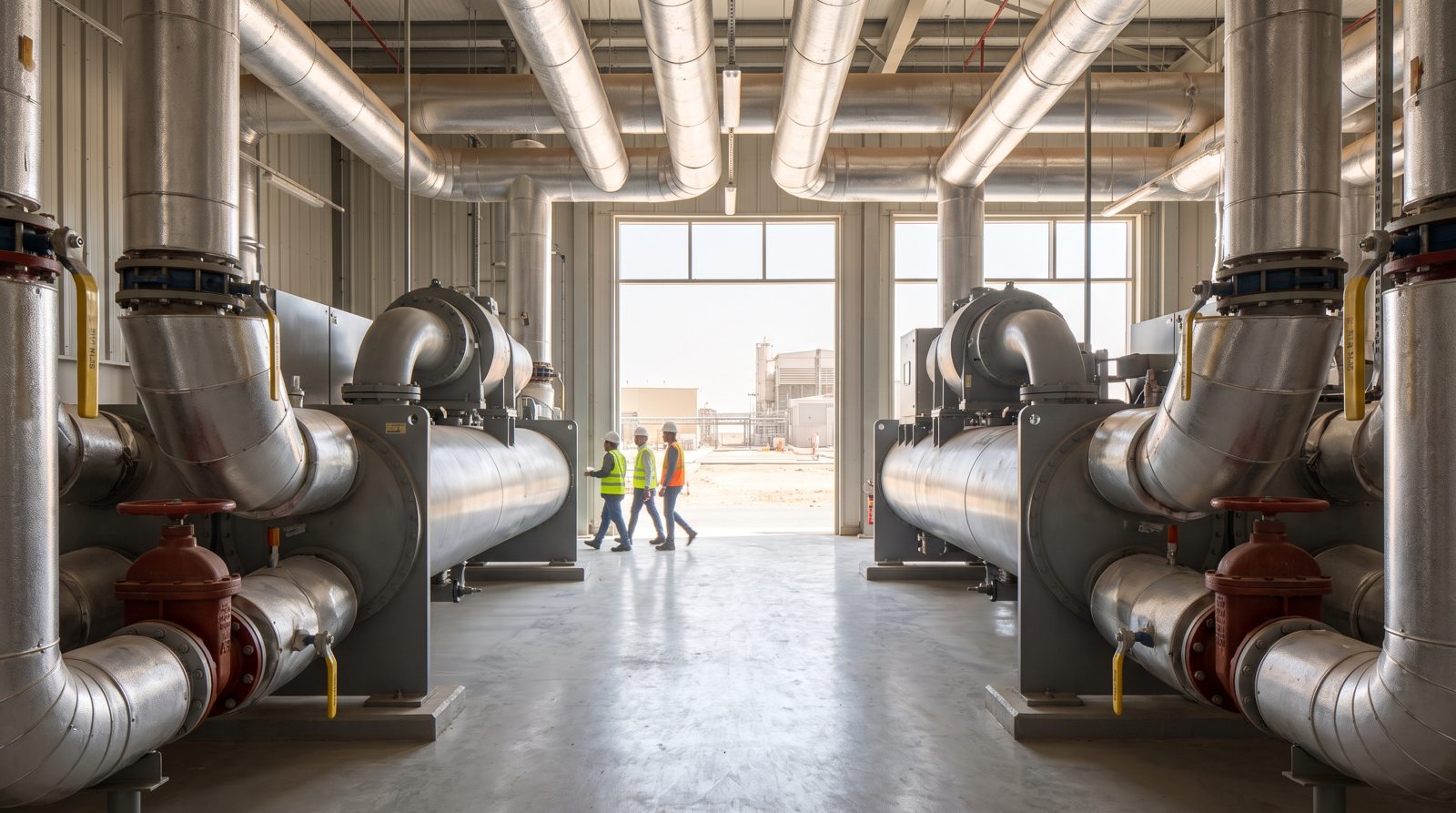
Precision cooling installation for data centers in Saudi Arabia depends on the plant behind it, and the chilled-water plant carries the redundancy. We arrange chillers, pumps and heat rejection as N+1 or 2N, with dual headers and isolation valves placed so that no single strainer, valve or controller removes the redundancy. When an existing hall needs plant upgrades, our chiller upgrades and replacement page and chiller installation page cover the machines, and our HVAC retrofit page covers phased upgrades around a live facility.
Power, controls and fire-protection interfaces
Cooling is only as available as the power behind it. We coordinate the mechanical scope with LV/MV distribution, main distribution boards, busway and cable management, so that pumps, CRAH fans and control panels are fed from the correct A or B source and transfer cleanly on a utility loss. Mechanical loads that must ride through a transfer are identified early so the UPS and generator sequence covers them, and feeder sizing follows the method in our voltage drop calculation guide.
Fire protection in the data hall is coordinated with containment, ceiling services and the cooling shutdown and restart sequence. The usual references are NFPA 75 for the fire protection of information technology equipment, NFPA 13 for preaction sprinklers and NFPA 2001 for clean agent systems, so a fire alarm event does not leave the hall without cooling longer than the design intends.
Working on live chilled water without taking a hall down
Existing data halls rarely have a valve exactly where an expansion or repair needs one. Draining a chilled-water loop to add a branch or replace a failed valve can mean taking redundancy away from the white space, or shutting it down. Two live-line techniques avoid that.
Hot tapping
A new branch connection is made on a pressurized, flowing chilled-water main through a valve and a hot tapping machine, so new CRAH units, in-row coolers or a future CDU loop can be connected without draining the system.
Pipe freezing
A freeze jacket and liquid nitrogen form a temporary ice plug inside the pipe on either side of a failed valve or strainer. The section between the plugs is isolated and worked on while the rest of the loop stays in service.
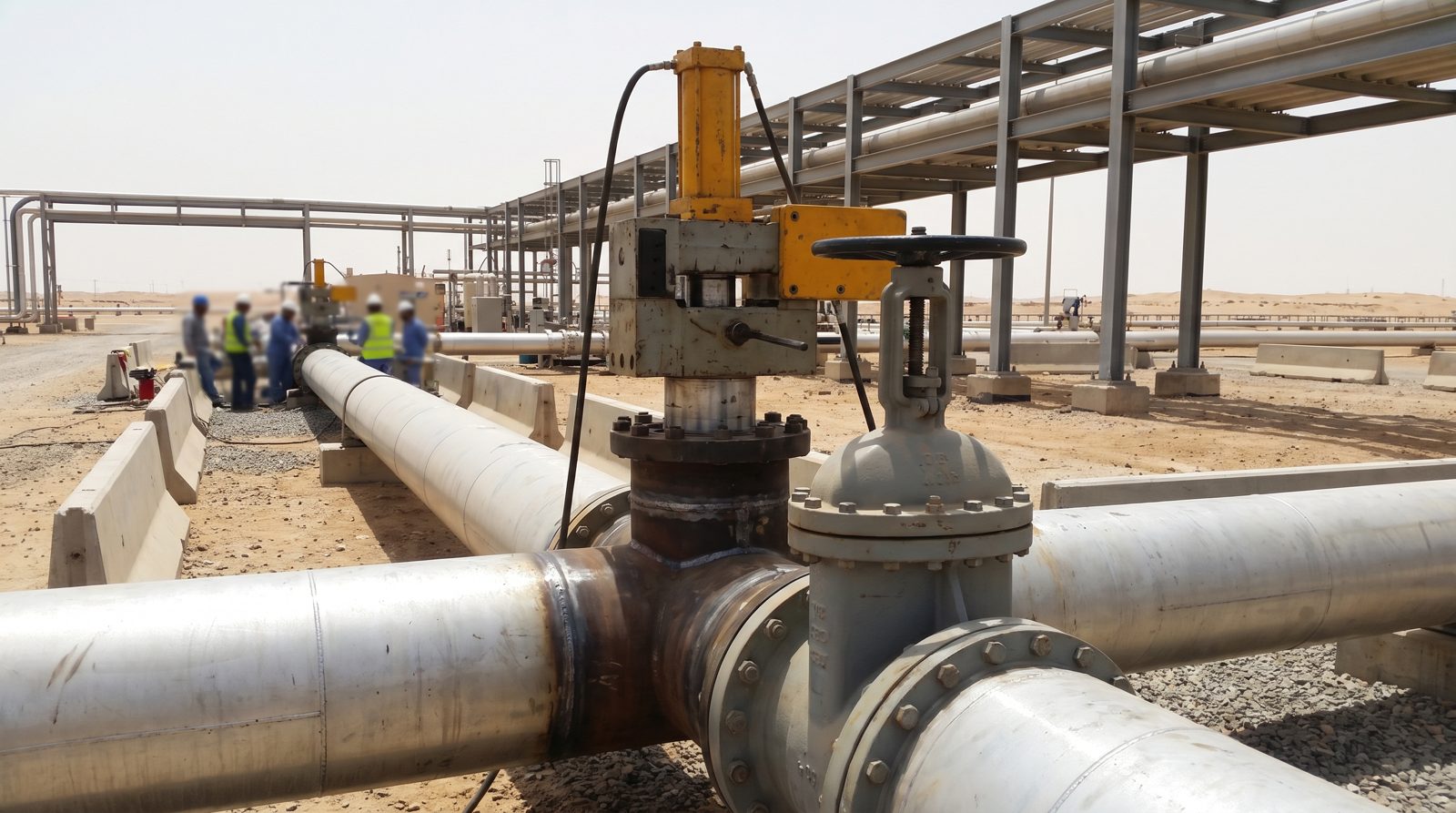
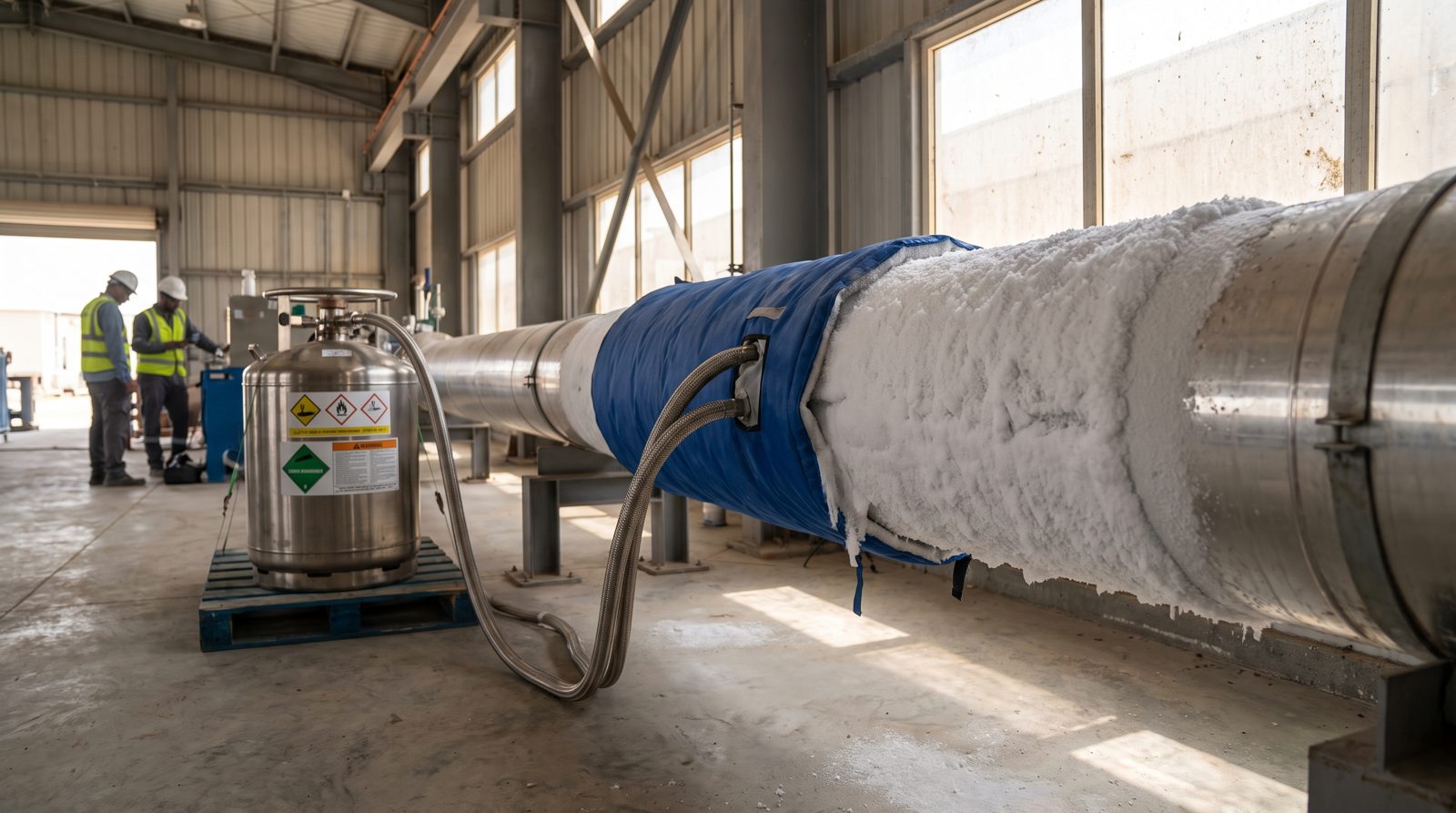
Both are planned activities, not improvisation. We start with a technical survey, material and wall-thickness verification, a pressure and temperature review, a method statement and a contingency plan agreed with the facility's operations team, so that the redundant cooling path is confirmed and ready before the work begins. The details are on our hot tapping services and pipe freezing services pages, our guide to pipe freezing vs draining the system compares the options on downtime and risk, and our solutions page lists the wider live-line capability.
How we deliver data center MEP work
Survey operating conditions
Review the design or the live site, and confirm loads, the redundancy scheme, isolation points and the operating limits the facility must hold during works.
Coordinate the interfaces
BIM-coordinated shop drawings, submittals and method statements that align mechanical, electrical and fire-protection scopes with the IT layout and operations procedures.
Install with QA/QC
Pressure testing, flushing and cleaning of chilled-water systems, torque and insulation-resistance records, and inspection at each hold point.
Commission and hand over
Factory witness testing, pre-functional checks, functional tests and an integrated systems test with load banks that proves failover, followed by as-built records and O&M documentation.
Why clients choose White Arch
We are one accountable contractor for mechanical, electrical and specialist scopes, with submittals, QA/QC and documented handover. Our standards page describes the quality framework, and our markets page lists the sectors we serve, including data centers. Learn more about White Arch, see our MEP contractor in Riyadh and MEP contractor in Dammam pages, or browse our services.
Frequently asked questions
What does a data center MEP contractor do?
A data center MEP contractor installs, tests and commissions the cooling, power distribution, controls and fire-protection systems that support IT equipment, and coordinates them so that redundancy and concurrent maintainability work as designed.
What are the Tier 3 data center requirements?
Under the Uptime Institute Tier Standard, Tier III means concurrently maintainable: redundant (N+1) capacity components and multiple independent distribution paths, with only one path required to be active, so any component can be maintained without affecting IT load.
What is the difference between N+1 and 2N redundancy?
N+1 adds one redundant unit to the quantity needed for the design load, while 2N provides two complete systems that can each carry the full load independently.
Is TIA-942 the same as an Uptime Institute Tier?
No. ANSI/TIA-942 is a separate standard with its own Rated-1 to Rated-4 levels, and Uptime Tier certification is issued only by the Uptime Institute, so specifications should name the scheme that applies.
What is driving the Saudi Arabia data center market?
The Saudi Arabia data center market is driven by the National Data Center Strategy, which targets about 1.5 GW of capacity by 2030, and by Vision 2030 digital programs. Installed IT capacity was about 222 MW in early 2025, with about 760 MW planned by 2030.
Is White Arch a data center MEP contractor in Saudi Arabia?
Yes. White Arch works as a data center MEP contractor in Saudi Arabia, delivering precision cooling, chilled-water plant and LV/MV distribution as one coordinated scope from its Dammam base.
Does White Arch work as a data center HVAC contractor in Riyadh?
Yes. White Arch works as a data center HVAC contractor in Riyadh, mobilizing a dedicated site team from Dammam for cooling installation, tie-ins and commissioning.
Is White Arch a data center cooling contractor in Saudi Arabia?
Yes. White Arch works as a data center cooling contractor in Saudi Arabia, covering CRAH units, in-row cooling, chilled-water plant and loops, containment and controls.
What does precision cooling installation for data centers in Saudi Arabia involve?
It involves installing and commissioning CRAH units or in-row coolers, chilled-water piping and valves, containment and controls, with redundancy and isolation arranged so that any unit can be maintained while the IT load stays online.
Can new cooling units be connected without shutting down a data hall?
Yes, in many cases. Hot tapping makes a new branch on a live chilled-water main, and pipe freezing isolates a section for valve work, both under a method statement and contingency plan agreed with operations.
Does White Arch work on data center projects outside Dammam?
Yes. White Arch is headquartered in Dammam and mobilizes Kingdom-wide, including Riyadh, the Eastern Province and the western region, with enquiries handled in English or Arabic.
Planning a data hall, upgrade or live-system intervention?
Send us your scope, drawings or site details. We will review them and respond with a coordinated proposal.
Request proposal WhatsApp +966 57 048 3020Email info@whitearch.sa